Blog Archive

Montessori Grammar: Noun Activities for Kids with Free Printable

Montessori grammar is one of my favorite things. Learning about nouns using the method is no exception. 

These beautiful Montessori Grammar: Noun Activities for Kids with Free Printable are sure to be a hit with your children in Montessori preschool and elementary classrooms.

The pictures are absolutely beautiful, all made with true-to-life images.

All of the activities are such fabulous ways to teach reading, spelling and vocabulary.

Montessori Grammar: Noun Activities for Kids with Free Printable

Montessori Grammar: Noun Activities for Kids


Montessori Grammar: The Noun 


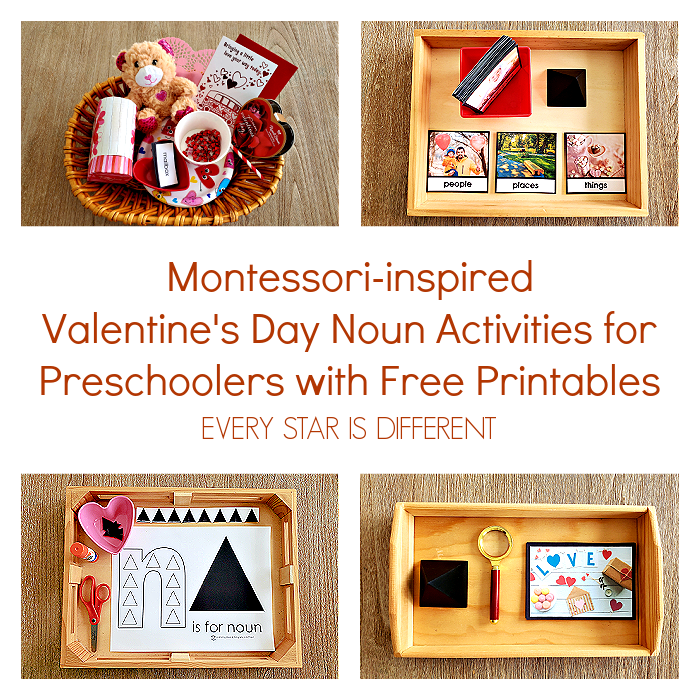
Montessori Grammar: Noun Sorting Activity

When I first introduced nouns the Montessori way, I provided resources that related to the shape and color of the Montessori grammar symbol along with multiple examples of nouns unsorted. This helped kids and co-op friends better understand and isolate the noun as a single aspect of grammar.

Sources: The large cards in this activity are from our Montessori-inspired Introduction to Grammar Printable Pack. Small sorting cards are from our Montessori Grammar: Nouns Printable Pack.

Montessori Grammar: Noun Sorting Cards


Montessori Grammar: Noun Sorting Cards

In this activity children sort the stack of cards into three noun categories: people, places, and things. 

This is a great way to help them remember the definition of a noun and think about the difference between people, places and things.

Source: I created the printable for this activity. It is part of my Montessori Grammar: Nouns Printable Pack.

Montessori Grammar: Singular and Plural Noun Sort


Montessori Grammar: Plural Nouns Sort

This activity introduces rules about changing singular nouns to plural nouns. 

There are several options as to how to go about this activity. You can choose to just use one rule and sort out cards as to whether or not the rule applies. This works well for children just starting to understand the difference between singular and plural nouns.

Montessori Grammar: Plural Noun Rules

Or, if students are up for a challenge and more advanced, you can have them sort cards under multiple rules.

Source: I created the printable for this activity. It is part of my Montessori Grammar: Nouns Printable Pack.

Montessori Grammar: Plural Noun Clip Cards


Montessori Grammar: Plural Noun Clip Cards

Once children have learned how to change singular nouns to plural nouns, these clip cards provide great opportunities for practice. I love that this activity also includes a spelling component which is always helpful.

Source: I created the printable for this activity. It is part of my Montessori Grammar: Nouns Printable Pack.

Montessori Grammar: Identifying a Noun in a Sentence


Montessori-inspired Grammar: Nouns Identification Clip Cards

Once children grasp the idea of a noun and are able to read, these clip cards are perfect when teaching how to identify a noun in a sentence. 

The kids read the sentence and then mark the noun in the sentence from the choices provided.

I love how this activity helps kids analyze sentences.

Source: I created this printable. This is a Subscriber's Only Freebie. For your copy, follow the directions below.

Directions on How to Obtain Subscriber Only Freebies

1. Click on the Subscriber's link at the bottom of this post.

2. Subscribe to our free newsletter.

3. Open the thank you message you receive in your e-mail, after subscribing. (Be sure to check your spam folder, as sometimes it ends up there.)

4. Click the confirmation link in the thank you message.

5. Once the confirmation is complete, you will receive another e-mail message with the Subscriber Only Freebies.

6. Click on link.

7. Find the printable pack you are looking for listed in alphabetical order, click on it, and voila!

We hope you enjoy your free printable.

Note: If you are already a newsletter subscriber, open your most recent newsletter. At the bottom you will find a link to the Subscriber Only Freebies page, along with the password in case you forgot it.


If you enjoyed this post, you may also enjoy the resources below.
    Valentine's Day Noun Activities with FREE Printables Valentine's Day Singular and Plural Noun Writing Strips Day of the Dead Grammar Activities with FREE Printables Montessori Grammar: Articles Printable Pack Montessori Grammar: Adjectives Printable Pack Montessori Grammar: Verbs Printable Pack Montessori Grammar: Prepositions Printable Pack Montessori Grammar: Adverbs Printable Pack Montessori Grammar: Pronouns Printable Pack Montessori Grammar: Conjunctions Printable Pack Montessori Grammar: Interjections Printable Pack Montessori Grammar: Environment Word Strips Bundle

Montessori Grammar: Noun Activities for Kids with Free Printable


Read More »

How to Document Your Child's Behaviors for Professionals and Specialists

I vividly remember the first time I started documenting Sunshine's behaviors for her developmental pediatrician to read. 

Each episode was written in detail in a notebook. The doctor dropped the book down on her lap, looking at me.

"I had no idea behaviors were this bad."

This documentation led to a huge influx of support from professionals and specialists. But the approach I was using to document wasn't one I could sustain. It was then that the doctor began to teach me how to document necessary details in short form.

Over the years as we've gone through multiple situations with schools, psychiatric wards, residential facilities, law enforcement etc. we've perfected the documentation process.

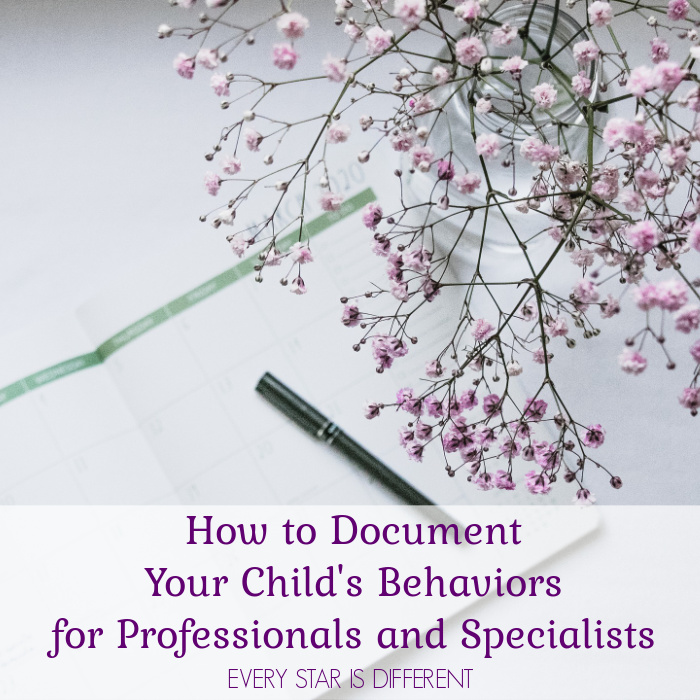
Today I'm excited to teach you how to document your child's behaviors for professionals and specialists in a way that helps you and your child receive the care and support you need.

Warning: This post contains information about behaviors at home and in residential care, related to Reactive Attachment Disorder, Bipolar, Depressions, Mania, Psychosis and Autism Spectrum Disorder and may be triggering to some.


How to Document Your Child's Behaviors for Professionals and Specialists


How to Document Your Child's Behaviors for Professionals and Specialists


Why document your child's behaviors for professionals and specialists?


In order for professionals and specialists to provide the support your family needs, they need to understand exactly what's going on. 

Diagnoses are based off of observation AND documentation. The more documentation you have the more accurate the diagnosis will be.

You as the caregiver are not going to remember all of the details when it comes time for an appointment. 

And even if you do, that doesn't mean you'll have the time or be able to report, especially if you're the only adult in the room attending to the child with disabilities.

Documentation shows that you are putting forth effort to understand your child and are willing to do the work to make necessary changes. This is VERY important.

As you find patterns, you can ask very specific and important questions. You can implement a new plan that may work better and decrease unsafe behaviors.

Documenting your child's behaviors for professionals and specialists allows them to give you feedback about what the most appropriate course of action may be when helping your child. 

At times, as caregivers in isolation, we may not understand the severity of what we're experiencing, until we share all of the details. In those times, we may not be able to make extremely difficult decisions on our own.

With documentation, professionals and specialists can help with those difficult decisions.

When do you document your child's behaviors for professionals and specialists?


If you are concerned about your child's behaviors, then it's time to document them. Whether your first point of contact is a pediatrician, a therapist, or educator, in order to help you help your child, they need to understand what's going on and how often it's occurring. 

If your child is seeing a developmental pediatrician, psychologist, or psychiatrist, providing documentation of behaviors is one of the single most important things you can do to to receive the help and support you need for your family.

If your child has an IEP and/or attends a school specific to their disability, documenting behaviors at home can be very helpful, especially when comparing behaviors at home and during a different time of day.

If you're having run ins with law enforcement over your child's behaviors or are fearful that might happen, it's time to document all that you can.

If you're just trying to understand the "why" behind behaviors, it's a good time to document.

If you're wondering about behavioral patterns, it's time to document.

If you're considering a medication or medication change, documenting behaviors is crucial.

There's honestly not a time when documenting behaviors won't be helpful. 

As one passionate about Montessori, I document as part of my observation. It always helps.

What types of documentation about your child's behaviors help professionals and specialists?


There are many forms of documentation that are helpful to professionals, specialists, and law enforcement.
 
At first a simple composition notebook where pages can't be torn out may do the trick, if behaviors are minimal or don't occur often.

Video footage of an incident is helpful, especially as it shows your response to the behavior. 

Again this works well if behaviors don't occur too often. Once they do, you're looking at a set up that is more complicated like a security system.

Charting the ABCs of Behavioral Analysis

Charting the ABCs of Behavioral Analysis can be extremely helpful when looking to understand the why behind behaviors and how you might tweak things as a parent in your response to behaviors.

But, my favorite type of documentation involves a monthly calendar, where I can simply write down the important information I need. Everything is in one place to observe patterns. 

Professionals and specialists tend to enjoy these most as well, especially since they cover an extended period of time in a way that's easy to view.

What do you use to document your child's behaviors for professionals and specialists?


As mentioned above, you can simply use a notebook or phone camera, but to create my favorite type of documentation, you need a monthly calendar.

I prefer to create a monthly calendar on the computer so I can change the font size depending on the day and how many behaviors there are. 

It's easier to color code things and add little notes in the empty boxes that I want to remember using a computer as well. Though, I am one to love a set of colored pens too. Lol.

You may also want clocks easily accessible if you're documenting specific times and durations of behaviors.

How do you document your child's behaviors for professionals and specialists?


Now that you understand the whys, when's, and what's, it's time to address the how.

Time of Behavior


The first important piece of documentation you need is the time of the behavior. You can also record how long the behavior lasts.

At home, I don't wear a watch. It's too unsafe to do so. When behaviors occur, I may or may not be holding my phone. Depending on the behaviors, I may not be able to hold my phone if I wanted to.

When Sunshine is home, I usually document time in increments of morning (wake up to noon), afternoon (noon to 4 PM) and evening (4 PM to bedtime). I may also include if a behavior was before or after a meal.

In Sunshine's residential treatment center, staff document behaviors specifically by time. They are kind enough to send this documentation to me.  I create my calendar and send it back to them for all of us to analyze. (Their documentation is in the form of lists, which is extremely hard to follow.)

Name of Behavior


The second most important piece of documentation is the name of the behavior. Depending on how many behaviors you're trying to track, will depend on how many names you'll want to include.

When Sunshine is at home, we only track aggressions and rank them: mild, medium, or severe. In her residential treatment center, many other behaviors are tracked.

Below I have included Sunshine's behavioral calendar from May of 2022 with the data that the residential facility provided me. (You can open the pdf with the link at the bottom of this post.) 

You can see how these times and behaviors are displayed.

Please note I am choosing to share this information as an example of what a calendar may look like with a child who suffers from Reactive Attachment Disorder, a mood disorder, autism, ADHD and more.

Sunshine is an incredible kid. These behaviors do not define her.

Sunshine's Behavioral Calendar May 2022

Now that you've seen an example of my calendar, you will also notice other info I like to include.

Important Information that Contributes to Behaviors


On Sunshine's calendar, you will note that she did not receive her Adderall dose on May 12th, (Parents and professionals are not perfect and do make mistakes.) This definitely had an effect on her day. 

May 5th, Sunshine had a visit with us. Understanding how that influenced her behavior that day and the day after is important.

May 2nd and 3rd, behaviors were worse and I do not see a reason for that change in behavior, so I note that by color coding the days orange.

On May 18th and 30th, Sunshine's school schedule was interrupted. It's important to document an increase or decrease in behaviors.

May 30th, Sunshine's depressive episode was so severe that she decided to call 9-1-1 wreaking havoc for everyone at the facility.

Patterns in Behavior


After a week or two, you may start noticing patterns in behaviors. It's important to highlight these patterns. As you document month after month, you may see monthly patterns.

I love to highlight these patterns and show them to professionals. They confirm to me that I'm not losing my mind AND professionals and specialists can help!

On Sunshine's calendar, you'll note that there are patterns in behaviors related to the day of the week, depending on if her preferred one-to-one is with her.

You'll note meal time is a struggle.

When it comes to monthly patterns, you can vividly see when Sunshine is in manic and depressive episodes and how long they last. Her behaviors were so severe that PRNs (medication) had to be given each time to calm her.

Charting these behaviors the way I did and sharing them with her team led to:
  • The psychiatrist increasing mood disorder meds at specific times of day
  • Extra supports being put in at meal time
  • More training for the one-to-one that was with Sunshine when her preferred person isn't there.

Now, to guide you a little bit further, I've included Sunshine's Behavior Calendar for June.

Sunshine's Behavioral Calendar June 2022

You will note a new pattern of behaviors occurs around gym class and outside time. 

Mealtime behaviors improve. 

Sunshine's manic and depressive episodes were a tiny bit more mild with no need for a PRN. The need for a PRN was completely unrelated.

Visits home to Sunshine's family went well, but she did display behaviors the days before and after the visits, which isn't great.

Sunshine really struggled with having a substitute teacher.

Days without her preferred one-to-one are still a struggle, but weekends are better.

Now, why am I sharing all of this with you?

Documentation leads to the most accurate help and support. When you are raising a child with Reactive Attachment Disorder, Autism, mood disorder, ADHD, and/or more, that's extremely important.

Understanding patterns and making changes accordingly can help both you and the child.

Viewing positive changes in behaviors can be so encouraging. If you notice a decline in behaviors, then you know to make an appointment.

Now, if you have a child who is displaying similar behaviors to Sunshine, you need help. You should not be doing this alone. These behaviors are not normal or okay.

Please note, your child is not wrong or bad if you feel the need to document behaviors. They are displaying unsafe behaviors, which affect everyone in the home. That's it. The goal is to have the unsafe behaviors diminish and eventually stop. 

Sunshine is an amazing girl. When she is good, she is incredible. Genetically, she received the raw end of the deal, and then trauma occurred, which was not her fault. I have faith that over time, most likely a long time, she can get better.

Documentation has helped all of us so much throughout our journey with her to keep her and everyone around her as safe as possible.

For those whose who want to receive more information and helpful tips regarding behaviors, be sure to sign up for our free newsletter by clicking the link below.


Don't forget to look at Sunshine's behavioral calendars up close by clicking the link below in order to help you make your own.


If you enjoyed this post, you may also enjoy the posts below.

Breathing Exercises for Kids with Free Printables How to Create and Use an Emotional Regulation Chart 6 Ways to Help a Family Going Through a Mental Health Emergency Mood Disorder Tips: How to Help a Child through Manic and Depressive Episodes Anger Management for Kids Four Prompts to Encourage Mindfulness in Children 4 Steps to Managing Aggressive Behaviors One Sure Way to Help Your Child Work Through Emotions Preparing for an appointment with a developmental pediatrician Diagnosis Day The Choice to Medicate Your Special Needs Child

How to Document Your Child's Behaviors for Professionals and Specialists


Read More »

A Halloween Party for Kids with Special Dietary Needs

 Halloween has always been an incredibly challenging holiday in our home due to special dietary needs, anxieties, and fears. 

Trick-or-Treating is not an option.

Instead we throw a Halloween party for our kids that allows us to meet all of their special dietary needs, calm anxieties, and avoid scary things that they fear.

This tradition is one that our children LOVE and look forward to.

A Halloween Party for Kids with Special Dietary Needs


A Halloween Party for Kids with Special Dietary Needs


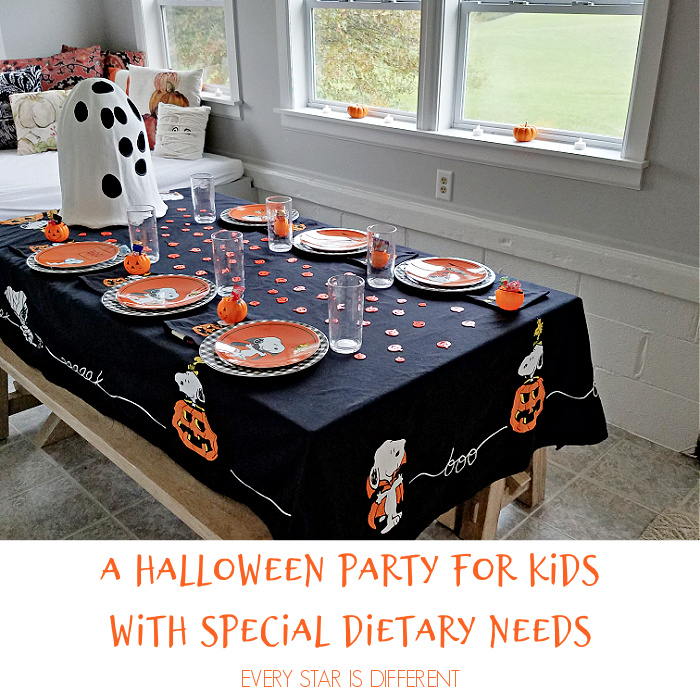
Each year we choose a different theme for our Halloween party. This particular year we chose "A Charlie Brown Halloween" theme. 


Sunshine was in love with the movie It's the Great Pumpkin, Charlie Brown, watching it on a daily basis. She's extremely sensitive to scary content, so I loved that the theme was one that was not scary.


Halloween Party Decorations


Our tabletop decor came from Pottery Barn Kids. Just because all of our kids have special dietary needs, doesn't mean that we can't make the act of eating extra special. A fun table cloth, plates, etc. usually does the trick!


A couple of things to make mention of...


I use fabric table cloths because my kids have a sensory aversion to plastic ones.


I use fabric napkins due to tactile sensory issues. It's pretty normal to have a freak out over using a paper napkin here.


I use melamine plates and cups because my kids aren't fans of paper plates, due to their flimsiness. Melamine is also much less breakable compared to glass or ceramic options.


You'll notice Halloween pillows in our reading nook, behind the table. These pillows are indoor outdoor pillows from Pottery Barn.


I am a HUGE fan of indoor/outdoor pillows because they're more durable and usually don't have buttons, snaps, or zippers. In other words, my kids can't destroy them. Lol.


I also love that indoor/outdoor pillows don't fade, even in a room full of windows where everything else does!


Halloween Party Attire


Since we don't go trick-or-treating, we are usually pretty flexible with Halloween attire. Some years we go with a simple new outfit, like shown above. Other years we may find a way to dress up. The kids were thrilled with these outfits as they all glowed in the dark.

For the longest time, none of our children enjoyed face paint due to how it felt as it dried and allergy issues. It's pretty impossible to eat in masks. Other than special Halloween hair accessories (if the girls are in the mood to use them), we don't do much with faces.

Food


Our Halloween dinner plans almost always include pizza. It's a meal everyone will eat AND we can find diet-friendly alternatives for crusts, sauce, and cheese.

Click HERE to see our favorite diet-friendly pizza crust recipe, using raw honey or other sugar alternative for Sunshine. One batch makes two personal pan pizzas.

We've found No Sugar Added Prego Sauce works great for our pizzas. For those who can't have dairy, we've found Daiya shredded mozzarella cheese to taste the best. It helps that it melts!

Our kids are huge fans of Hormel Turkey pepperoni, which is safe for everyone in our home. I usually opt for a ham and pineapple pizza, but that's just me. Lol.


Besides pizza, I usually put a few diet friendly candies in a cute container, like the pumpkins shown in the image above and below.


Each child has their own assigned seat at our dinner table. This makes it easy to ensure that each kiddo receives only candy that's diet friendly for them.


I love giving candy with dinner on Halloween because it helps curb the anxiety and excitement related to Halloween candy.


After dinner the kids are given their Halloween candy. This is always a highlight of our night as the kids already know what they're receiving and love to trade with siblings when possible.

Why do they know what they're receiving?

Before Halloween, we take the kids to our local Walmart and let them each pick out two bags of candy that are diet friendly, that they'd like for Halloween.

This is a Halloween tradition they look forward to every year.

Once the candy bags are handed out, the kids sort their candy, and the trading begins where possible.


(This Halloween party occurred before Sunshine was put on a dairy-free and gluten-free diet.)

The sorting and trading process usually takes quite a while, but when all is said and done, everyone has sorted their candy at least once and enjoyed a few pieces.


If you're at a loss when it comes to candy due to the severity of special dietary needs and/or sensory needs, be sure to check out the post below for some ideas.

Halloween Candy: Gluten Free, Dairy Free, Soy Free, Corn Free, and Refined Sugar Free

Halloween Candy: Gluten Free, Dairy Free, Soy Free, Corn Free, and Refined Sugar Free


After dinner and candy bags, we usually watch a Halloween movie together. Sometimes we do a Halloween dance party in the living room. Other times we may play a Halloween game. It all just depends on the kids.

After the night's entertainment, the kids put on their new Halloween pj pajamas and take one more picture.


Halloween pajamas are a big deal in our house. The kids look forward to them every year, especially ones that glow in the dark. Lol.

There is always a way for kids with special dietary needs to enjoy Halloween, even if it looks different than it might for others.

So long as they enjoy it, that's all that matters!

For those who are looking for more holiday and special dietary needs resources, be sure to subscribe to our free newsletter by clicking the link below.


If you enjoyed this post, you may also enjoy the resources below.

Disney Villains Halloween Party Witches and Wizards Halloween Party Our Halloween Countdown Fall Kickoff Party Montessori-inspired Halloween Themed Language Bundle Montessori-inspired Halloween Language Bundle in Cursive Montessori-inspired Halloween Jack-o-lantern Printable Pack Montessori-inspired Halloween Animals Printable Pack


A Halloween Party for Kids with Special Dietary Needs


Read More »