Blog Archive

Breathing Exercises for Kids with FREE Printable

When Sunshine is feeling strong feelings, taking deep breaths helps her to not aggress or engage in negative behaviors in the moment.

However, she does often find breathing boring and complains that it doesn't seem to help with the actual emotion behind the behaviors that she's feeling at the time. 

That was the case, until we introduced the breathing exercises for kids mentioned in this post.

Sunshine absolutely LOVES them. They seem to work every time, so long as her brain isn't too activated.

I created a free printable to go along with the breathing exercises so that no matter where we go, we can bring the visuals to cue Sunshine when they are needed. For her, the visual is everything.

Breathing Exercises for Kids with FREE Printable

Confession time.

I can not take any credit for these breathing exercises. Full credit goes to Kira Willey, author of Breathe Like a Bear, and her amazing illustrator Anni Bets.

Breathe Like a Bear Book


Kira Willey wrote a magnificent book full of 30 different breathing activities that help children to calm, focus, imagine, energize, and relax.  (We do not use the energize activities with Sunshine as they activate her brain too much.)

Our entire family LOVES this book because it takes deep breathing to the next level, helping children visualize and engage with their mind and body in positive ways that not only help with behaviors, but also the emotions behind them.

Breathe Like a Bear

How doe Kira Willey do this you ask?

Each breathing exercise comes with a story and visualization. The exercise takes the child out of current circumstances and transplants them into another that is positive and enjoyable. 

For Sunshine, this is HUGE. 

Her brain deactivates. 

Instead of going to a dark place in her mind while she takes simple deep breathes, she visualizes the breathing exercises and goes to a happy place.

Once the result of the breathing exercise has been reached, she is able to talk about her emotions calmly and safely.

We absolutely LOVE the book, Breathe Like a Bear.

Breathe Like a Bear Cue Cards


Now, I've shared all of the pros of this book, but I must confess there is one con.

This book does not fit in my purse and is really hard to carry around to other places outside of the home!

When I wrote this post the author had not created portable cards to carry around to use in all settings. 

Fortunately, cards are now available!

Breathe Like a Bear Cue Cards

These 50 Breathe Like a Bear Mindfulness Cards include the beautiful illustrations and instructions for each breathing activity included in her book and more!

 Before these cards were create, I made my own Breathe Like a Bear Cue Cards that I would slip into my purse or my youngest daughter's backpack on the go. 


FREE Breathe Like a Bear Cue Cards for Kids


Now let me clarify what these cards are and aren't.


  • These cards do NOT include instructions and stories written by Kira Willey related to the breathing exercises found in the Breathe Like a Bear book.
  • These cards do NOT include the beautiful illustrations created by Anni Betts, nor claim to be anything like them.
  • These cards do NOT replace the incredible effort that Kira Willey and Anni Betts put into their masterpiece.
  • These cards do NOT work without having full details of the breathing activities in the book, Breathe Like a Bear. 
  • These cards DO give true-to-life visuals that represent breathing activities listed in the book, with a title and a one word description of what type of breathing activity each card represents.
  • Those who choose to use these cards DO need to purchase the book in order to understand what any of the titles and exercises are.
  • These cards DO allow me to provide Sunshine with visuals for the breathing activities in the book, Breathe Like a Bear, when we are on the go and I'm unable to transport the book, but only after we've used the book to practice and memorize all that's necessary to remember while using the cards.
  • These cards are for personal use only.

How We Use the Breathe Like a Bear Cue Cards


Option 1:


These cards were created two years ago when we thought that Sunshine would be returning home to us sooner than later.


Before her last hospitalization we read through the book together and had her choose one to two breathing activities that she liked most. 


After practicing the breathing activities when she was calm to ensure that she had mastered them, I would initiate their use when emotions were high.


The goal was to have Sunshine eventually initiate them, choosing one or two a day to use when necessary.


Selecting her breathing cards for the day would be part of her initial check-in of the day.


These exercises worked every time, when Sunshine's brain wasn't too activated.


Option 2:


 Big emotions are not just something that happens at home. These cards are perfect for carrying in my purse when I don't have the book on hand to use.


When we prepare to leave, Sunshine will pick one or two breathing exercise cue cards to bring along if necessary. That way when she struggles, she has something tangible and visual to remind her of what to do.


If you do not own the book, Breathe Like a Bear, I HIGHLY recommend it. Though it's designed for children ages 4-8, I love it as an adult!


Finding the breathing techniques that work for your child specifically is so important. Understanding that every child is different is crucial to success.


Directions on How to Obtain Subscriber Only Freebies

1. Click on the Subscriber's link at the bottom of this post.

2. Subscribe to our free newsletter.

3. Open the thank you message you receive in your e-mail, after subscribing. (Be sure to check your spam folder, as sometimes it ends up there.)

4. Click the confirmation link in the thank you message.

5. Once the confirmation is complete, you will receive another e-mail message with the Subscriber Only Freebies.

6. Click on link.

7. Find the printable pack you are looking for listed in alphabetical order, click on it, and voila!

We hope you enjoy your free printable.

Note: If you are already a newsletter subscriber, open your most recent newsletter. At the bottom you will find a link to the Subscriber Only Freebies page, along with the password in case you forgot it.


If you enjoyed this post, you may also enjoy the resources below. 


4 Steps to Managing Aggressive Behaviors Four Prompts to Encourage Mindfulness in ChildrenOne Sure Way to Help Your Child Work Through Emotions How to Create and Use an Individualized Emotional Regulation Chart Anger Management for Kids Morning and Bedtime Routine Visuals and Supports
Read More »

How to Create and Use an Emotional Regulation Chart

 It's no secret that Sunshine REALLY struggles with emotional regulation and anger management. 

One of the biggest challenges we have when others care for Sunshine is that they do not understand what Sunshine's behaviors mean.
 
When caregivers miss important emotional regulation cues,  everyone suffers. 

Instead of working on prevention and regulation strategies, caregivers end up focusing on behavior strategies.

This is why it's so important to teach emotional regulation in ways that a child can understand. 

Today I'm going to show you how to create and use an emotional regulation chart for your child!


How to Create and Use an Emotional Regulation Chart


Emotional regulation is something that we've always worked on at home in various ways. It was super easy when Sunshine was home all the time.


But when she started attending a day program emotional regulation was not a focus in the classroom. Sunshine suffered because of this.


After some great meetings with her team, they introduced a color based emotional regulation program and chart at school. We carried over what was being taught at home, adding on to what we were already doing.


The program used at school introduced green representing the emotion happy. Blue stood for sick and/or sad. Yellow stood for emotions like anxious, nervous, scared, etc. Red stood for angry.


The concepts taught in the program at school were great, but based on Sunshine's struggles with brain activation, we realized we needed to add another emotion option to her chart, which we call "fire red." 


Sunshine reaches "fire red" when her brain is activated to the point of having a behavioral seizure. During this time, behaviors do not stop until the seizure is finished. Most often these behaviors include hurting others and sometimes Sunshine hurting herself.


The goal with Sunshine is to always keep her as calm as possible. As she identifies what color she's on at check-ins throughout her day, the goal is return to green as quickly as possible through using various coping skills.

Using a chart with colors and corresponding emotions is a huge help! It's the perfect visual for kids.

How to Create an Individualized Emotional Regulation Chart


1. Identify target emotions and assign color to them.


When creating an emotional regulation chart, you do not need to use the same colors and emotions introduced by Sunshine's school. You can choose any colors and emotions you'd like based on observations of what your child will respond most positively to.

If you're enlisting the help of your child when creating a chart, have them pick their own colors and match them to emotions.

For us, the colors introduced at school transformed into multiple emotions based on observation and identification.

2. Choose a way to represent emotions that match colors.


I chose to use emojis to represent corresponding emotions in our chart because Sunshine LOVES emojis and still can't read.

If you choose to create a chart similar to mine, it's super easy to purchase emoji stickers and use them.

Other options you may consider are drawings, photographs of the your child in different emotional states, or simply writing out the emotions depending on your child's age.

Whatever your choose is completely up to you! 

If it's possible, and your child is willing, they could participate in this process. 

3. Create a three column chart.


The first column is for colors. Next comes corresponding emotions. Last is a check in space is available for the child to use when possible.

4. Place color markers and corresponding emotions in the appropriate places on the chart.


This is the fun part where everything comes together!

Children may enjoy putting their chart together using glue, stickers, markers, crayons, or whatever you choose to use.

I created ours on the computer since Sunshine isn't at home right now. This way it can be printed out and used in multiple settings. 

When she does come home, I'm excited for her to create her own.

This is Sunshine's chart!

Sunshine's Emotional Regulation Chart

This chart was created by me and is designed specifically for Sunshine. It is not available for use by anyone else for free or through purchase.


Please know it's okay if each color has only one corresponding emotion. 

Sunshine's chart is based on her ability to recognize different emotions. If your child isn't able to recognize more than five simple emotions, only include those.

5. Decide how your child will do an emotional check-in.


The third column is a place where the child does a check-in about how they're feeling. It can be used in various ways.

Your child can draw the emotion their feeling in the proper box.

Your child can use a clothespin and clip it to the correct box.

Your child can draw a check mark in the correct space.

In all honesty, the sky is the limit!

Whichever way you choose to use the last column, be sure to use cardstock and/or laminate your chart for durability. 

I will be asking Sunshine to use white board markers to draw the correct emoji face when possible at home.

6. Make a list of emotions and corresponding behaviors.


DO NOT SKIP THIS STEP!  

It is one thing to teach your child how to identify their emotions by color, but a completely different to identify emotions by behaviors, which is the whole point of creating the emotional regulation chart in the first place.

Take time to observe your child.

Observe the child's behaviors and emotions.

Ask questions based on your observations. 

"I am observing that when you are feeling nervous when playing, you are unkind to your friends. Is this correct?"

Obviously you will modify questions based on what the child can understand and answer.

Write down behaviors that you can associate with emotions. 

This is your guide to helping your child understand emotional regulation.

Sunshine's list is below. I use colors rather than emotions to make it easier.
Sunshine's Emotional Regulation Colors & Corresponding Behaviors

Once you have your list, use it!

When using the emotional regulation chart, the goal is to teach your child how they feel and what behaviors they display when they have that feeling.

From there they can learn to identify the emotion and behaviors themselves and decide to change them to those that are more positive.

We have handed this list out to Sunshine's day program, respite workers, and every RTC team she has had. When they choose to use it, it makes such a difference.

Adults are able to catch Sunshine before she escalates too far and activates her brain.

Over time the goal is to teach Sunshine to catch herself before she activates, after lots of practice and constant use of the chart, associating behaviors with emotions the entire way.

It may take a LONG time, but I do believe it's possible!

Be sure to subscribe to our FREE newsletter if you'd like to receive more support and resources related to emotional regulation, 


If you enjoyed this post, you may also enjoy the resources below.

Anger Management for Kids Four Prompts to Encourage Mindfulness in Children 4 Steps to Managing Aggressive Behaviors One Sure Way to Help Your Child Work Through Emotions 5 Lessons to Teach Kids About Balancing Emotions Fun Ways to Teach Children About Emotions
Read More »

How We Do Montessori Middle School at Home

This year we have made the transition from a Montessori elementary focused homeschool experience to one that is Montessori middle school focused. 

I won't lie. The transition has been a work in progress and has taken most of the school year. 

We started this journey in September. Now, in March the kids are finally settling into it and are enjoying most moments.

Instead of transitioning to a Montessori-inspired middle school model all at once, we've introduced it piece by piece over the school year.

I did this to prevent unnecessary meltdowns and negative behaviors. 

I am so excited to finally share the many phases of this transition and how we do Montessori middle school in our homeschool environment.

How We Do Montessori Middle School at Home

How Do I Know it's Time to Switch to a Montessori Middle School Approach to Learning?


At the beginning of the school year, my three older children were ages 12,13, and 14 and documented by our school district as being in grades six, seven, and eight.

Dinomite, 14, and Bulldozer, 13, are autistic and have developmental delays as well as academic delays in the areas of math and writing. On average they're about two to three years behind their peers.

Princess, 12, who suffers from Reactive Attachment Disorder, is quite advanced in academics, but struggles with emotional development.

As a result, all three are learning the same things at the same time, at about the same pace.

Due to the three kids' interests, learning preferences, and the concept of following their lead, we are still working on some Montessori elementary curriculum, especially in the areas of language and math. 

But, what I've noticed this year, is that the kids prefer learning using paper and pencil, over the use of Montessori materials and printables.

They are craving research and showing an interest in writing assignments that are larger in nature.

Emotionally they are at a place where they can handle homework, studying, and preparing for tests. In fact, they've requested these things. 

I love their new desire to practice and master a skill over an extended period of time. Their piano and foreign language skills are blossoming this year.

For us, the transition to Montessori Middle School wasn't about the curriculum and checking off boxes in regards to what the kids had learned. It was about HOW the kids' preferred learning styles were changing.

This change in learning style is directly related to brain development and the planes that Maria Montessori speaks about.

How Do I Change the Learning Environment to Accommodate Montessori Middle School Learning?


I must admit, the hardest aspect of transitioning to a Montessori-inspire middles school environment for me was changing my classroom set up.

I LOVED the Montessori preschool classroom with all of the beautiful and attractive work set up on trays for the kids to choose from. 

I LOVED preparing the trays!

When we transitioned to an elementary set up, I learned to love the bigger materials and bigger work.

Instead of using trays and baskets for individual activities, they were used to store printables that went along with materials.

In both preschool and elementary settings, I was still able to set up an area of the classroom for each subject.

But the transition to middle school...

There are no more trays or baskets, except for those that hold paper for writing.

There is no longer a set of shelves for each subject. 

Instead, the kids use one shelf for each subject they're studying, where they store their notebooks, textbooks, workbooks, reference materials, and necessary tools like calculators, protractors, rulers, etc.

The rest of the classroom has turned into my office and storage for important papers.

If the kids had desks, notebooks, textbooks, workbooks and tools would be stored there, leaving only references for each subject on the shelves. But, they still very much enjoy working wherever they'd like in the house, and have opted to use the shelves to store items.

We all use dry erase lapboards when learning a new skill and for practice.

How Do I Create Middle School Routines and Schedules?


Settling into a new routine and schedule definitely took time when transitioning into Montessori-inspired middle school learning.

Based on the kids' skills, abilities, and needs we have created a routine and schedule that works for us. This may not be a set up that works for you, and that's okay.

Lessons


Monday through Friday, we begin with math and language, reviewing assignments and progressing through lessons. 

The kids receive math and language homework four days a week.

Lessons go at the kids' pace. Some new concepts take only a day to master. Others can take a week or two. 

When everyone feels comfortable understanding concepts and any processes that are necessary to solving problems, we move forward.

After math and language lessons, we rotate through other subject areas. We follow an eight day schedule. Each day of the eight day schedule is dedicated to a different subject. The eight day schedule is followed Monday through Thursday.

The kids have selected which topics they'd like to study for the school year, outside of the basic subject areas.

  • Day 1: Geography
  • Day 2: Human Anatomy
  • Day 3: Art
  • Day 4: Foreign Language
  • Day 5: Oceanography
  • Day 6: Practical Life
  • Day 7: Music
  • Day 8: History

If it's Day 4 of our schedule, I present a foreign language lesson, review any assignment that was given, and check in to see where the kids are at, and if they need extra support.

At the end of the review and lesson, the kids are given an assignment to complete by the next Day 4 in the schedule. 

The kids are also given daily practice assignments. 

On foreign language days, they may receive a new vocabulary list or a set of verbs to practice until the next scheduled foreign language day.

Their favorite foreign language assignment is to watch a full movie in their foreign language, writing down ten new vocabulary words or phrases and meanings to share when we next meet.

Disney+ is such a fantastic resource to find movies in Spanish, French and German with matching subtitles. 

The kids watch a new movie every week, because they love this assignment so much. 

Their ability to read and pronounce words in their selected foreign language is skyrocketing.

Work Time


Lessons for the day usually take about 60-90 minutes. The kids are then given work time where they have a choice of working on any assignments they feel they may need help on.

I am available during that time to answer any questions or provide any extra support that may be needed.

Rough drafts of essays are reviewed. 

Art projects are underway. 

The computer may be occupied with one of the kids typing a final draft of a paper.

If someone is struggling in math, that kid may take that time to ask for help.

The kitchen may smell of fresh ingredients being used in the preparation of lunch.

Nature observations may be underway.

On days when everyone needs help, I set a timer for each child, giving them 20-30 minutes.

Work time lasts between 90 minutes and 2 hours, and takes us to lunch time, where we continue our read aloud tradition.

Homework


After the lunch, the kids are free to create their afternoon and evening schedule to ensure that all homework assignments and daily practice tasks are complete.

Each day the kids are required to complete 30 minutes of cardio exercise. They usually choose to play sports outside or ride my exercise bike.

All three kids are also required to practice piano for 30 minutes each day to prepare for their lessons on the music day of our schedule.

Other tasks include studying, math and language homework, essays, and projects they're working on.

The kids choose what and when they work on these things, knowing when they are due. 

During homework time, I am not available to help. They are to complete assignments on their own or ask a peer for help.

Homework time, including exercise and piano, usually takes anywhere from 2 to 3 hours, give or take.

The goal of homework time is to encourage as much independence as possible in the areas of time management, effective study methods, and responsibility of assignments.

In our home, we have a designated media time from 6 PM until 8 PM where the kids can use any and all of their media devices, watch TV, etc. All of them finish their homework, eat dinner, do chores, and shower before media time begins, creating their own schedule for the afternoon based on their individual needs.

Friday Game Day


As mentioned previously, Monday through Thursday, we follow our eight day schedule. On Fridays, we take a break and dedicate time to playing a board game or card game together during work time.

We have found that Game Day is just as important as any other day in the week. So much learning takes place on Game Day.

The kid work on communication skills, emotional regulation, problem solving, strategizing, working as a team (when playing cooperative games), positive peer interactions, and so much more.

We take turns picking out a game. A new person selects a game each week. 

Even the process of playing a game that's not a favorite, because someone else has chosen it, is teaching the kids so much about compromise.

I think my favorite part about Game Day is that Fridays are always a day the kids look forward to. They may think it's just about fun, but they're actually working harder on Fridays than some other days during the week.  Lol.

How Do I Incorporate Service into a World with COVID-19 and Other Extenuating Circumstances


Part of the Montessori middle school curriculum is service. This was the last piece of the middle school experience that we've added.

Due to COVID-19 and Sunshine's monthly visits and appointments, it's been difficult to secure a place for continued service over an extended period of time.

Instead, we have set the goal of completing one service project a week. The kids come up with the plans. They prepare. Then they execute the task.

I love that they are focusing so much on helping others and starting to develop skills necessary to secure employment in the future.

How Do I Continue to Inspire a Love of Learning through the Middle School Years


The transition to homework, tests, and grades can be a difficult, but it is necessary in preparation for higher education and employment. 

Learning time management, prioritization and organization skills can be a huge challenge for some. 

The sooner we can start teaching these skills, once the child is emotionally and developmentally able to handle the tasks, the better the results will be.

The challenge is keeping the focus on the process and not the results. It's not about the test grade. It's about preparing and being ready for the test.

So how do you balance all of the necessary and still make things fun?

You continue to follow the child!

You go at the child's pace.

You allow freedom to choose course work in areas where it is possible.

You introduce topics, and wait for further interest before pursuing them.

You offer choices in learning and how to demonstrate mastery of a skill.

Every child is different. 

This idea does not change once a child reaches puberty and embarks on their middle school journey.

If anything, middle schoolers need even more support than elementary students, due to the massive changes their bodies and hormones are going through.

Despite these changes, middle schoolers are capable of so many incredible things! 

Sit back. Relax. And enjoy the ride!

Now that we have fully transitioned to this model I am LOVING it!

If you would like to read what others have to say about Montessori Middle School, check out the articles below.


To follow our own personal Montessori Middle School journey, be sure to subscribe to our FREE newsletter.


If you enjoyed this post, you may also enjoy the following resources below.

Gingerbread Christmas STEM Projects American History for Kids: The Montessori Way A Year's Worth of Monthly Service Projects for Families 12 Months of Family Service Projects Best Tips for Montessori Homeschooling The Ultimate Montessori Planner

Read More »

When Traditional Mental Health Therapy Doesn't Work...

Mental health therapy and I aren't the closest of friends. If I'm being completely honest, we're not even acquaintances.  

Throughout my many years of life I have seen mental health therapy manipulated to benefit those in power.

I have experienced being on the receiving end of services where the mental health professional caused more harm than good.

I have worked with many mental health professionals who feel that a child's behaviors is the fault of the parents, and therefore the parents need to be "fixed."

And when it's come to Sunshine, I have worked with so many mental health professionals who think they know how to help, don't listen to our experiences as parents or experiences we've had with other professionals, and then when their way doesn't work, they give up and Sunshine gets burned again.

It can be extremely frustrating when traditional mental health therapy doesn't work, especially after hoping it would so many times.


When Traditional Mental Health Therapy Doesn't Work...


Therapy for those Who Have Experienced Trauma


It's been a little over a year since I started working with a therapist who specializes in trauma for myself.

Taking that leap of faith, after so many negative experiences, was HARD. If you'd like to know just how difficult it was, I wrote about my first session HERE.

Traditional mental health therapy models were definitely not a great fit for me, after so many prior experiences that were negative.

I was so thankful that the therapist I met with was well versed in many modalities and was willing to put the hard work and effort into finding the perfect fit for me.

She recommended we start with the book, The Body Keeps the Score. This book introduces many types of therapies that may work for people who have experienced trauma.

Originally I was hoping to try EMDR or something similar, but after reading the book mentioned above, I found IFS or Internal Family Systems model to be the most intriguing.

Fortunately for me, my therapist was trained in the model and more than willing to try it out!


What is IFS?


Internal Family Systems or IFS is a therapy that emphasizes the idea that we all have multiple parts. 

Each part plays a role in how we respond to the world around us. 

Parts develop as we experience trauma, as ways to survive and cope with the situations we are placed in.

Some of these parts are protective. 

Others like to act as managers. 

We have parts that have been exiled.  

Not all parts get along.

And when the parts don't work correctly, it's as if a fire has broken out, and firefighters are called in to respond.

IFS focuses on identifying and working with parts to help an individual understand their own trauma response and how it works.

From there, the individual self works with the parts to develop a plan for the future that is more balanced and healthy, with all parts better understanding their role in the present, which may differ from the past.

Eventually the exiles are unburdened and the self is able to take the lead, with the parts understanding and loving their present roles in helping the individual remain as healthy as possible.


Thinking of One's Self in Parts


IFS may seem odd at first, but if you pause for a moment and think about how you talk about your feelings, it makes so much sense.

How often do you say,

"Well, part of me feels this way, while another part of me feels this way."

IFS just takes things further, by naming and identifying parts and working with them to help you be the best you can be, while fully respecting each and every part.

I can say for me, understanding all of my parts has been life changing.

Giving each part a name has provided such comfort.

So much power comes from understanding all of my parts and how they work.

I am a healthier and happier person.


IFS for the Individual


Due to my struggles with trusting mental health therapists and any modality, once I showed interest in IFS, my therapist recommended reading Internal Family Systems Therapy by Richard C. Schwartz. 

This book is not light reading, but actually a text used to train therapists how to do IFS.


Internal Family Systems Therapy


Each week I'd read a little bit and bring questions to therapy. 

At the same time, each session, my therapist would help me with my individual IFS work.

Words can not express how amazing this journey has been and how much it has helped me.

I highly recommend it for anyone who's looking for a new way to work through trauma.  I will be continuing for as long as my therapist welcomes me back!


Internal Family Systems Manual


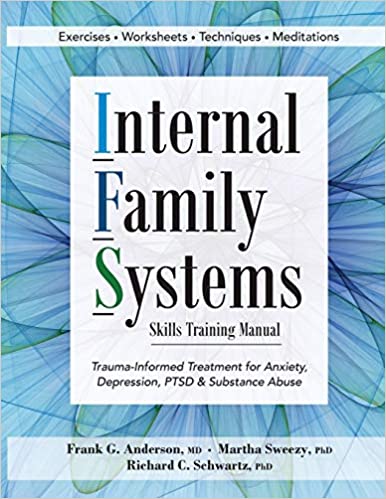
Now that I've finished the text one time through, I have slowly started to work through the corresponding workbook, Internal Families Systems Skills Training Manual as I read the original text a second time through.


Who can benefit from IFS?


IFS was can and has been used in a variety of cases ranging from trauma to addictions, to personality disorders.

As much as some of my parts continue to try to convince me that I am wrong, bad, and not okay, my therapist, and many before her, have stated that I don't suffer from an anxiety disorder, depression, PTSD, ADHD, or anything else. 

My anxiety is not severe or inhibiting.

I am not a depressed person.

Yes, I have experienced trauma, but it can't be considered POST traumatic stress disorder, if I'm still going through it, which I am, in regards to Sunshine's situation.

I do not have ADHD, even though my trauma response feels like ADHD on steroids. But unlike ADHD, it comes with a fog that takes over.

I don't have a personality disorder.

I don't suffer from addictions.

Yet, IFS is perfect for me because it helps me work through my body's response to trauma from the past and present, and fears of what may happen in the future.


IFS for Couples


Trauma doesn't just affect individuals in family. It affects the marriage and family dynamics. 

My husband and I have attempted couples therapy for the last three months, without using the IFS model. 

It has not gone well and is extremely triggering. 


Internal Family Systems Couple Therapy


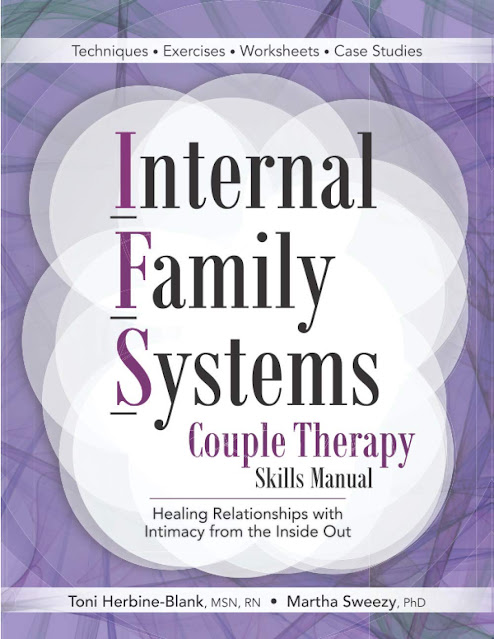
Due to these struggles with traditional couples therapy approaches, and our love of IFS, we've decided to switch modalities and use the Internal Family Systems Couple Therapy Skills Manual.

My therapist, trained in IFS, has agreed to help us with anything we may have questions about.


IFS for Children


One of the greatest benefits of IFS therapy and training has been how I've been able to apply it to situations at home with my kids, especially Princess.

She is very quick to view herself as ALL bad, when in fact, it is only parts of her that feel that way.

Understanding her many parts has been eye opening and empowering for her.

When it comes to tense situations between us, instead of conversations becoming heated, all I have to do is ask Princess, what part is in charge right now, and she calms right down. 

The part is then free to express feelings without judgement, and we work to help her part(s) feel safe.

Princess has gone as far as drawing images of her parts, what they look like, and how they work.

She absolutely loves this modality. Unlike others we've tried, this one is actually working.


Internal Family Systems Therapy for Children


I am super excited to start using the Internal Family Systems Therapy with Children book to help guide Princess' progress.

IFS has not been offered at any of Sunshine's residential placements, but if it was, I believe it would also help her.


Try It!


My husband was laughing at me today as I expressed my love for IFS. He knows more than anyone how much I dislike mental health therapy, especially many of the traditional modalities. 

He worked as a mental health therapist and has tried for years to persuade me of the benefits of mental health therapy, despite what I've experienced in the past, and what our family has endured over the years.

Today he declared victory, even though I told him, I was only in support of IFS. 

If you're struggling with traditional mental health therapy and feel it's not working, research local IFS trained therapists in your area and try it. 

IFS is a complicated approach, so I can't emphasize enough how important is to work with a therapist  who has training and experience with it. 

It may just change your life for the better!

To receive more mental health resources and support from us, be sure to subscribe to our FREE newsletter.


Click HERE to Subscribe to our FREE Newsletter


If you enjoyed this post, you may also enjoy the resources below.

  The Realities of Reactive Attachment Disorder and Mental Health Therapy Internal Family Systems: A Child's Parts Reactive Attachment Disorder Fits: Did I Do Something Wrong? To Be a Mother of a Young Child with Reactive Attachment Disorder Our Pediatric Mental Health Crisis My Child Wants to Kill Herself, Now What? Why Self-Care is So Dang Hard for Parents Raising Kids with Trauma Holidays and PTSD:  A Parent's Guide to Survival

Read More »

Reactive Attachment Disorder and Food Struggles

 “We need to talk about Sunshine’s eating habits. She’s refusing multiple meals a day.”

The clinical director of Sunshine’s RTC continued explaining everything that had been tried.

This is the third RTC that Sunshine has been placed in due to behaviors related to Reactive Attachment Disorder, and other emotional and developmental disabilities.

They had given Sunshine food choices at this RTC.

They had offered to have her help prep her meals.

They made her favorite foods.

Still the problem was worsening.

A list was read out loud of all the food that Sunshine had refused over the past two weeks. It included hamburgers, French fries, and potato chips, all of which are her favorites.

No information that the clinical director shared was new.

This is what life has always been like with Sunshine due to Reactive Attachment Disorder and Food Struggles.


Reactive Attachment Disorder and Food Struggles


Reactive Attachment  Disorder and Food Struggles


The History


Sunshine has a LONG history with food, and it’s not a good one.

Throughout the years we’ve dealt with food refusal, food gorging, vomiting, gagging, stealing food, and so much more.

This is all completely normal with a child who has Reactive Attachment Disorder.

This has been on top of reflux, food allergies, and other special dietary needs.

Sunshine has had a barium study. She’s been to a swallowing specialist. An OT has worked with her.

We have tried so many different methods to empower Sunshine at mealtime. 


  • Use a Montessori weaning table
  • Teach practical life skills related to food preparation
  • Let Sunshine prepare her own food to the ability that she’s able
  • Let Sunshine meal plan
  • Take Sunshine grocery shopping to ensure we have foods that she loves
  • Provide choices to choose from
  • Improve sensory experiences related to food

Still, Sunshine refused to eat on a regular basis.

Mealtime became a battle ground.

Often the issues started even before a meal was prepared, especially at dinner time. If Sunshine didn’t like what we were having all sorts of behaviors would start.

The screaming would come first, then would come the physical aggression.

When my husband wasn’t home, I’d always need to make sure the refrigerator was stocked full of grab and go foods for my other children to prepare on their own. Sunshine’s outbursts and aggressions could last hours, to the point that I could not prepare a meal.


The Doctor's Orders


I spoke with Sunshine’s developmental pediatrician about these struggles early on. 

As a mother, I felt like the most horrible person on earth. 

Nothing I tried would help with the mealtime drama, which was affecting Sunshine’s health.

The developmental pediatrician was kind yet blunt.

If she was refusing to eat, then I needed to do what was necessary to make sure she ate. 

If that included a stand off until she conceded, then that’s what needed to happen.

If she would not feed herself, then I was to feed her.

Refusing to eat was not an option.

So that’s what we did.


The Nightmare


We continued to do all the things mentioned above AND…

At each meal, I set the rule that Sunshine had to eat however many bites of food she was in years of age. When Sunshine was five years old, she needed to take five bites.

If she decided to refuse and throw a fit, I’d wait until the fit was over, and we’d start again.

If Sunshine decided to spit her food out, the count started over.

If Sunshine became aggressive, I’d wait it out and we’d go at it again.

It was a nightmare.

I felt like a monster.

This was not the mother I wanted to be.

But, year after year, this proved to be the only way to ensure that Sunshine would eat.

You see, Sunshine has absolutely no concept of when she’s full or hungry. This dates back to trauma she experienced during the first six months of her life (before she came to us).

Food trauma is real.


Validation


As I shared with the clinical director what had worked at home all those years, frightened out of my mind to be judged as being that parent, the clinical director surprised me.

“Okay. We’ll do it.”

I was speechless.

“Are you sure? It’s going to result in so many more aggressions.”

She was sure.

Sunshine’s refusal to eat has become that dangerous.

Part of me was frustrated.

After six months of working with professionals, my advice is the best idea they have.

Yet, if my advice is the best option they have, that means that no matter how horrible it felt forcing Sunshine to eat all of those years, it was the right thing to do.

If Sunshine is refusing to eat even more there than she was at home, that meant that the whole mess wasn’t my fault.

I’m not really great at accepting that things aren’t my fault.

I do not have confidence in my parenting abilities after how horrible experiences have felt.

So for good measure I reminded the clinical director of a few other things.

  • Sunshine’s GABA supplement should not be taken with food, or else it causes her tummy to be upset.
  • A side effect of one of Sunshine’s meds is constipation. If she’s constipated, she’s not going to eat much.
  • Sunshine had COVID-19 a month ago and it may have changed her taste buds.

But ultimately, all of us agreed that it seems all of this comes down to control.

Reactive Attachment Disorder goes far beyond the challenges of parenting a picky eater or one with sensory struggles.

Why I Share


I’m sharing this experience because I know there are other caregivers out there struggling with food issues related to Reactive Attachment Disorder. They are real. You are not alone.

Documentation is so important in these cases.

Keep a food journal.

Write down behaviors.

Try everything and anything that professionals suggest. 

Document if it works and the consistency in which it works.

Talk to your child’s pediatrician and other specialists.

You need a team.

You need support.

Battles as severe as Sunshine’s regarding food are not normal. Seek help.

You are not a bad caregiver for doing so.

This is not your fault.

For those looking for more support and resources related to Reactive Attachment Disorder be sure to subscribe to our FREE newsletter.


If you enjoyed this post, you may enjoy the resources below.

What Is Reactive Attachment Disorder A Minimalist Montessori Home Tour: The Kitchen How to Discipline a Child with Reactive Attachment Disorder Food Issues When Food is Your Child's Enemy Day to Day Life Parenting A Child with Reactive Attachment Disorder
Read More »